![[Translate to English:] Logistikberatung | IGZ](/fileadmin/user_upload/Blog/2024_und_davor/Logistikberatung/igz-blog-logistikberatung.jpg "[Translate to English:] Logistikberatung | IGZ")
Why professional logistics consulting is so important
Read more



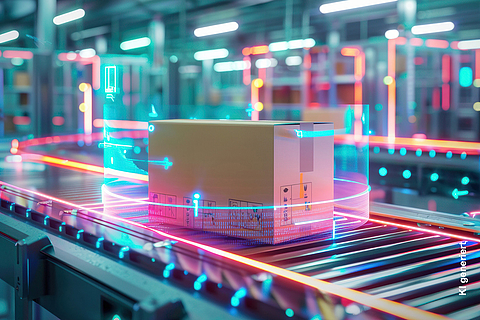
A new item arrives at the receiving area. Within a few minutes, it’s determined whether it will move smoothly through the warehouse later on, or whether incorrect or missing master data will require manual intervention or even error correction.
In theory, the item could be put into storage immediately. Instead, the process often begins with searching for data, measuring with a folding rule, and, if necessary, manual data entry: How big is the product? How much does it weigh? What is the packaging unit? Can it be stored in the automated warehouse? What transport and handling information is needed?
What may sound like just a few pieces of information actually determines the entire subsequent path of the item. Modern warehouse and transportation logistics are based not only on shelves, conveyor systems/robotics, or vehicles, but above all on data. SAP systems for managing automated supply chains make millions of decisions every day, and all of them rely on the same foundation: complete and reliable master data.
The more complex supply chains and product assortments become, the higher the demands on data quality. Today, some of our customers manage several million items with different packaging variants, weights, dimensions, nestability, stackability, and other logistical characteristics. Industry requirements vary, whether in mechanical engineering—with a wide variety of items and work-in-progress (WIP) inventories—or in retail and e-commerce, where items and sourcing channels are constantly changing, potentially leading to varying packaging sizes and variants. At the same time, expectations regarding speed, transparency, and process reliability are rising.
Even the absence of a single data record or minor errors can have unintended consequences. Incorrect weights, incomplete packaging information, or erroneous dimensions lead to problems—for example, in goods receipt, location assignment, order picking, packaging, and shipping—and hinder automated material flows.
Automated or machine-assisted master data capture provides a solution to this problem. Data is captured digitally—and, if the process allows, even automatically—upon goods receipt, checked against rules and validations, and then transferred to the SAP system landscape without any media breaks. The effort required for manual maintenance is significantly reduced, while data quality improves sustainably.
Automated master data capture means much more than simply digitizing an item. Modern solutions automatically identify items, capture dimensions, weight, and packaging information using scanners, cameras, and measurement technology, validate the data against defined rules, and then transfer it directly to SAP.
High-quality SAP master data delivers its greatest value particularly in SAP S/4HANA, SAP Extended Warehouse Management (EWM), SAP Transportation Management (TM), and SAP Logistics Management. Digital master data can be imported directly into SAP via standardized interfaces. As a result, new items are available for operational processes more quickly, without the need to manually maintain information.
Artificial intelligence is also becoming increasingly important. It can extract product information from documents, detect duplicates, or intelligently fill in missing or varying details—for example, using an AI-driven putaway strategy (Smart Slotting by IGZ). Ideally, employees will only need to review exceptions or errors, rather than having to manually enter all the information.
IGZ’s SAP EWM Best Practice Smart Item Scan (SIS) demonstrates how this approach can be implemented in practice. Our solution helps companies automatically capture logistics master data using AI. Items are identified, categorized, measured, and weighed. The information is processed in SAP EWM and is available to everyone across the unified SAP system landscape even before a product reaches its first storage location. Companies with a wide variety of items, multiple warehouse locations, or growing product ranges benefit
most from standardized master data automation. New products can be integrated more quickly, processes become more scalable, and the database remains consistently accurate over the long term—an important prerequisite for further automation steps and AI-powered applications.
Would you like to automate your master data processes or sustainably improve data quality in your SAP logistics? Our experts at IGZ would be happy to advise you and work with you to develop a solution that fits your processes and requirements.
We look forward to hearing from you!