
Digital Supply Chain (DSC)
Read more



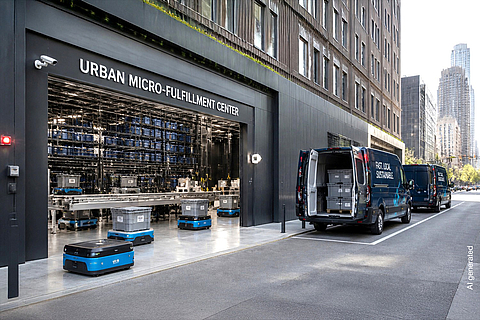
Imagine online orders reaching your customers within a few hours—not from a distant central warehouse, but directly from a highly automated micro-fulfillment center (MFC) right in the heart of the city. Short delivery routes, high availability, and maximum process efficiency: What was long considered a vision for urban logistics is increasingly becoming the strategic standard in e-commerce fulfillment.
The driving force is clear: advancing urbanization, rising online orders, and growing customer expectations regarding delivery speed. At the same time, transportation costs are rising, city centers are becoming denser, space is becoming scarcer, and sustainability is taking center stage. Micro-fulfillment offers a solution that combines speed, efficiency, and cost-effectiveness.
For years, the last mile has been considered the most expensive and complex part of the supply chain. Long transport routes, traffic congestion, stricter emissions requirements, and tight delivery windows are increasing the pressure on retail and logistics companies.
At the same time, customers today expect:
Central distribution centers are increasingly reaching their limits. Micro-fulfillment centers (MFCs) bridge this gap by bringing warehouse capacity closer to the end customer while operating with a high degree of automation.
Micro-fulfillment refers to compact, typically automated warehouse locations in urban areas that are specifically designed for fast e-commerce fulfillment. Unlike traditional fulfillment centers, these facilities prioritize proximity to customers, speed, and space efficiency.
Typical characteristics of a micro-fulfillment center:
The benefits for retailers are clear:
Micro-fulfillment thus serves as the link between brick-and-mortar retail, e-commerce, and urban logistics.
For micro-fulfillment to be economically viable, a high degree of automation is crucial. Compact shuttle warehouses, autonomous robotic solutions, and automated picking systems enable high throughput rates in a limited space. Equally important is intelligent IT control. SAP Extended Warehouse Management (SAP EWM) forms the backbone of modern micro-fulfillment solutions:
Platforms such as the SAP Business Technology Platform enable the integration of additional automation and analytics capabilities. This results in scalable micro-fulfillment architectures that integrate seamlessly into existing ERP and logistics processes.
The use of micro-fulfillment centers is gaining momentum across all industries.
Across all industries, one thing is clear: micro-fulfillment increases service levels, reduces transportation costs, and improves competitiveness.
As much potential as micro-fulfillment offers, its implementation requires a clear strategy and thorough planning. Key success factors include:
IT integration, in particular, is often the deciding factor in long-term success. Isolated, siloed solutions increase complexity and costs, while end-to-end SAP-based architectures ensure stability and future-proofing.
Micro-fulfillment is increasingly evolving from a pilot project into an integral part of modern logistics strategies. Companies benefit from:
With increasing urbanization and rising online sales, this trend will continue to gain momentum. Those who invest early will gain a competitive edge in service quality, efficiency, and sustainability.
Urban logistics architectures place high demands on processes, systems, and scalability. IGZ helps companies systematically develop micro-fulfillment concepts and build them on a robust SAP logistics foundation—from process analysis and system architecture to the integration of automated warehouse technology.
The focus is on:
This is how micro-fulfillment centers are created—centers that not only enable fast deliveries but can also be operated in a way that is economically viable, sustainable, and future-proof in the long term.
Those who rethink urban logistics create real competitive advantages—and micro-fulfillment is a key component of this. Talk to us if you want to set up your e-commerce logistics in an urban, efficient, and scalable way.
We look forward to hearing from you!

