![[Translate to English:] Logistikberatung | IGZ](/fileadmin/user_upload/Blog/2024_und_davor/Logistikberatung/igz-blog-logistikberatung.jpg "[Translate to English:] Logistikberatung | IGZ")
Why professional logistics consulting is so important
Read more



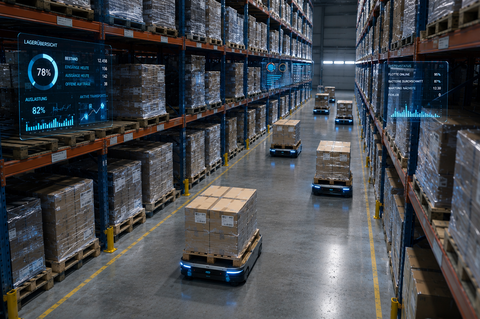
Shelves are full, yet items are still missing. Safety stock levels are high, yet supply bottlenecks still occur. Traditional inventory management is increasingly reaching its limits. Dynamic markets, volatile supply chains, and rising customer expectations demand more precise, faster, and more transparent processes.
Artificial intelligence (AI) is therefore fundamentally changing how companies monitor, plan, and manage inventory. Instead of static inventory counts and reactive planning, data-driven systems are emerging that analyze inventory in real time, generate forecasts, and automatically support decision-making. For many companies, AI is thus becoming a key driver of modern warehouse logistics.
Traditional inventory management is often characterized by manual inventory counts, delayed postings, and isolated data silos. This leads to common problems:
At the same time, customer expectations are rising: shorter delivery times, consistent availability, and maximum transparency. Companies must plan faster, forecast more accurately, and identify risks early.
AI is becoming a key technology here. It enables inventory control that not only documents but also actively manages inventory.
AI in the warehouse means, above all, using data intelligently. Machine learning, predictive analytics, and automated decision-making models continuously analyze information from systems such as SAP EWM, ERP, sensors, or IoT platforms.
The result:
Instead of retrospective analyses, this enables proactive inventory control. Decisions are no longer based solely on experience, but on reliable data patterns.
Applications range from operational inventory management to strategic supply chain optimization:
The greatest benefits are realized when AI is integrated directly into existing SAP processes. SAP Business AI, the SAP Business AI Platform (BAIP), and AI capabilities in SAP EWM or ERP enable seamless integration into operational workflows.
This offers clear advantages:
While external standalone AI solutions can provide added value in specific cases, they often increase integration effort, maintenance costs, and complexity. SAP-native AI, on the other hand, ensures stable, maintainable, and cost-effective system landscapes in the long term.
AI takes inventory management to a new level. Companies benefit from:
The trend is clearly moving toward predictive supply chains: In the future, warehouses will respond autonomously to changes in demand, risks, or market signals.
Companies that integrate AI into their inventory management early on lay the foundation for resilient, efficient, and future-proof logistics processes.
Implementing AI-powered inventory control requires more than just technology. The key lies in the interplay between process understanding, SAP integration, and practical logistics experience. This is exactly where IGZ comes in.
IGZ supports companies throughout their entire transformation toward intelligent inventory management—from strategic assessment and the identification of suitable AI use cases to operational implementation in SAP EWM, SAP Business AI, or on the SAP Business AI Platform (BAIP). The focus is not on individual tools, but on end-to-end processes, stable data structures, and architectures that are scalable over the long term.
IGZ not only provides consulting but also develops and implements intelligent solutions that are directly integrated into the existing SAP landscape, such as our twice-award-winning autonomous AI control center.
The result is inventory control that combines operational efficiency with strategic management capabilities—a system that is not only transparent but also actively manages operations—operationally efficient and strategically effective.
Intelligent inventory management reduces costs, increases resilience, and sustainably strengthens your ability to deliver.
Talk to us and let’s work together to make your inventory control future-proof.
We look forward to hearing from you!